Radio Control
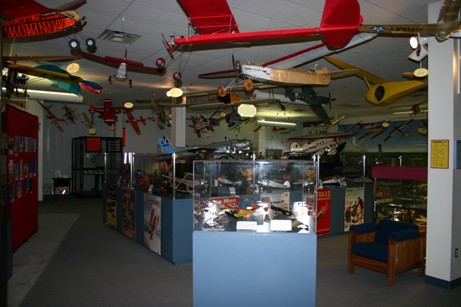
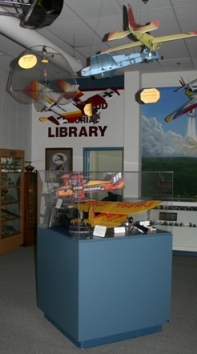
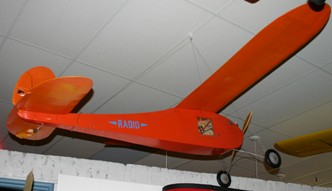
In this portion of the gallery, visitors can see how Radio Control (RC) has developed from the first rudder-only models to pylon racers, aerobatic models, and helicopters.
The first official contest for RC model airplanes was technically held in 1936, but no contestants flew radio-controlled models that year. The first official RC contest with entrants was in 1937. And it was not until the 1970s that this form of aeromodeling became so massively popular.
Watch many types of RC aircraft fly in the AMA film, Diamonds in the Sky, produced by Jay Gerber.
|
|
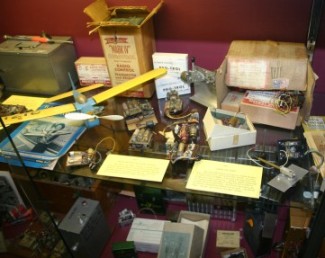 Along the east wall is a collection of Radio Control systems that have significantly changed since their introduction into society. The early vacuum tube radios are very different from the much smaller and more reliable modern computer and spread spectrum radios. |
||
|
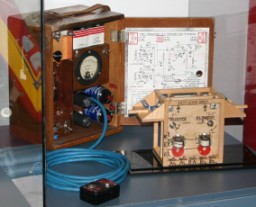
The first truly successful Radio Control airplane was the Big Guff, built in 1938 by the Good brothers, Walt and Bill. See the Big Guff fly in the AMA film, The Pioneers, produced by Jay Gerber. |
This case contains a reproduction of the radio transmitter and receiver used by the Good brothers to fly the Guff. |
||
|
This portion of the exhibit traces the history of RC Pylon Racing. |
As soon as full-scale jets began flying, modelers attempted to make reproductions. At first, the model aircraft looked like jets but had propellers, and then the idea of a ducted fan became popular. Today, many jet modelers use miniature turbine engines to power their aircraft. |
||
|
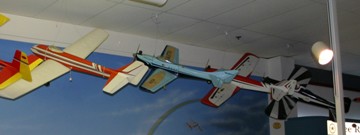
These aircraft are Park Flyers, smaller and lighter electric powered models that have become very popular over the last few years. |
|||
|
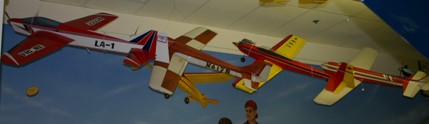
These are Radio Control Aerobatic (also known as Pattern) aircraft. Watch these type of aircraft fly in the AMA Film, The Seventh World Championships of Radio Control Aerobatics, produced and directed by Jay Gerber. |
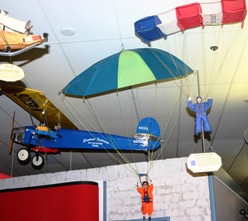
Another type of aeromodeling activity is radio-controlled skydiving. These skydivers are released from a radio control airplane, and the modeler actually operates their arms to control the parachute, just like full-scale skydivers. |
||
|
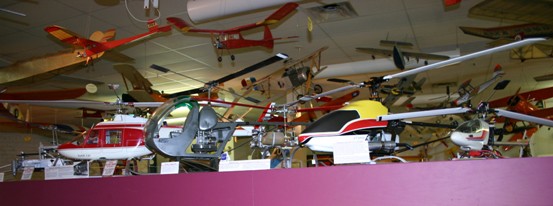
This is just a sample of the Radio Control helicopters on display at the museum. |
|||

.JPG)